
Wedding planner pay confuses people because two different jobs share one title. An employed wedding coordinator at a venue earns a salary. An independent wedding planner runs a business and earns whatever her calendar times her fee turns out to be. The numbers below cover both, and they are current for 2026.
The short answer
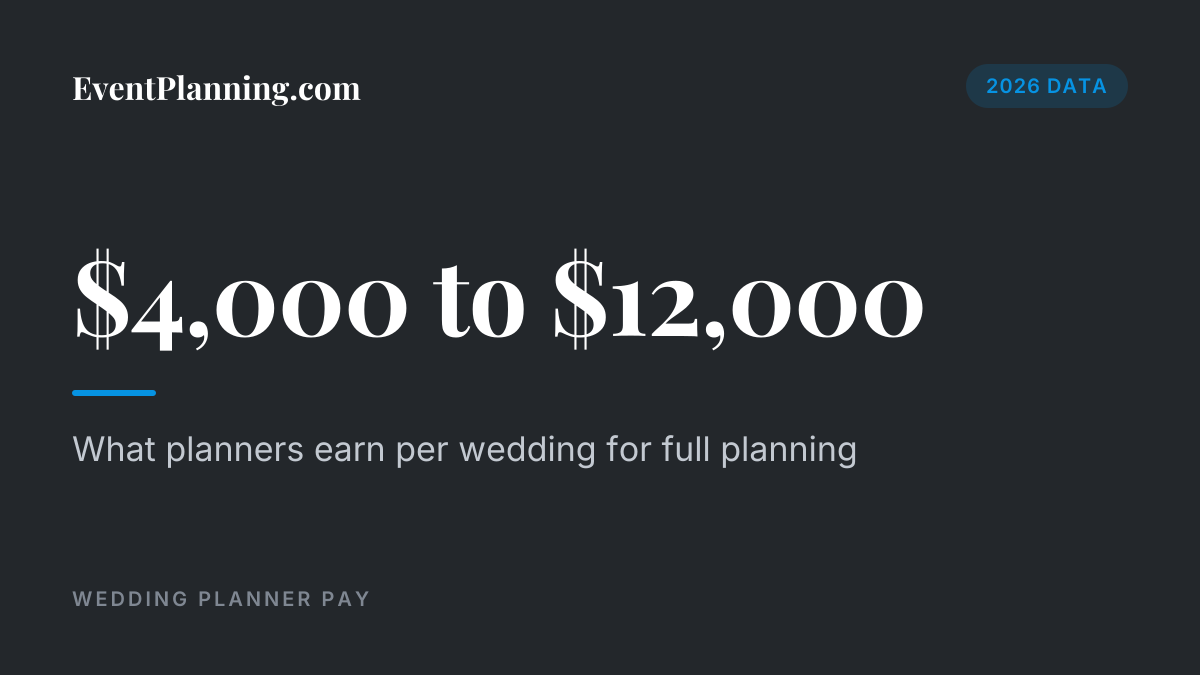
Independent wedding planners charge per wedding: $1,500 to $3,500 for month-of coordination, $2,500 to $6,000 for partial planning, and $4,000 to $12,000 for full planning at typical US budgets. A full-time planner booking 20 to 30 weddings a year grosses roughly $60,000 to $135,000 before business costs.
Employed planners and coordinators fall under the federal wage data for event planners: a median of $61,160 a year, with hotel and venue roles clustering a bit lower and corporate work a bit higher.
What wedding planners charge per wedding
These are the 2026 US benchmark ranges we publish across our tools, with real published anchors from working planners' rate cards:
What wedding planners charge per wedding
Typical US ranges, 2026. The dot marks a working planner's published rate card, verified June 2026.
| Service level | Typical range | Published anchor* |
|---|---|---|
| Month-of / day-of coordination | $1,500 to $3,500 | $2,300 |
| Partial planning (final 3 to 4 months) | $2,500 to $6,000 | $3,500 |
| Full planning (12+ months) | $4,000 to $12,000+ | $5,500 |
| Luxury full service | 10 to 15% of budget | $4,000+ minimum |
*Anchor figures from a working planner's published client rate card, verified June 2026. Luxury metros run far higher.
Two things decide where you sit inside those ranges: your market and your proof. A planner with a portfolio of executed weddings in Dallas quotes differently than a first-year planner in a small town, and both are doing it correctly. The mistake is quoting hourly. Couples buy a calm wedding, not your hours, and planners who sell packages consistently out-earn planners who bill time. Our free pricing calculator returns a quote range adjusted for your market and experience.
What that means per year
Annual income for an independent planner is bookings times average fee minus business costs, and the honest math looks like this:
| Stage | Calendar | Gross |
|---|---|---|
| Side business, year one | 8 month-of coordinations at $2,000 | $16,000 |
| Full time, established | 22 weddings, mixed packages, $3,800 average | $83,600 |
| Boutique lead planner | 30 weddings, full-planning heavy, $4,500 average | $135,000 |
Subtract 20 to 30 percent for real business costs: insurance, software, marketing, and assistants on wedding days. Those scenarios bracket what we actually see. The ceiling comes from capacity, since a Saturday can hold only one wedding, which is why established planners raise fees rather than volume, and eventually add associate planners who run weddings under their brand.
Seasonality is the other honest caveat. Most US markets concentrate weddings from late spring through fall, so independents book 70 to 80 percent of their revenue in half the year. Good planners treat winter as sales season and summer as delivery season, and their cash flow planning respects that.
There is a second side to these numbers. To see the same market from the client's point of view, we break down what clients actually pay a wedding planner by service tier.
Employed wedding planner and coordinator salaries
If you want weddings without running a business, the employed paths are venue coordination, catering sales, and associate roles at planning firms. Federal wage data does not break out wedding specialists, but these roles sit inside the event planner occupation, where the median is $61,160 a year and the middle half earns $46,970 to $78,790. Venue and hospitality employers cluster somewhat below that median, and they often add commission for coordinators who sell, which is how the strongest venue people beat it. Coordinator postings in wedding-heavy markets typically start between $38,000 and $45,000; see current event planning jobs for what employers are asking and paying now.
Location moves these numbers meaningfully. Wedding-dense states publish their own wage data: California's median is $71,120, Texas sits at $57,470, and Florida at $60,270. The full salary guide covers every state.
Raising your income usually starts with how you price. Our full guide covers how to charge for event planning, including flat fees, percentages, and day-of rates.
How wedding planners raise their income
Four levers, in the order they usually pay off:
- Package architecture. A clear three-tier menu with a strong middle anchor out-earns improvised quotes. Planners who present month-of, partial, and full options convert better and upsell naturally.
- A niche. Cultural specializations, destination weddings, and specific venue styles let you quote at the top of the range with less pushback, because couples compare you to fewer alternatives.
- Vendor relationships. Preferred-vendor status at two or three venues is a client pipeline that costs nothing but consistency. It is also where most first referrals come from.
- A verifiable credential. Nothing replaces a portfolio, and a credential a couple can verify online in seconds helps at the exact moment you are asking for the top of your range. We compared the major options honestly, ours included, in the certification guide.
Wedding planner salary FAQ
How much do wedding planners make per wedding?
Month-of coordination typically pays $1,500 to $3,500, partial planning $2,500 to $6,000, and full planning $4,000 to $12,000. Luxury full service is usually quoted at 10 to 15 percent of the wedding budget with a stated minimum.
How many weddings can one planner handle per year?
A full-time solo planner comfortably delivers 20 to 30 weddings a year with a mixed package load. Full-planning-heavy calendars run lower, month-of-heavy calendars can run higher, and Saturdays are the hard constraint.
What does an entry-level wedding coordinator make?
Employed coordinator roles typically start between $38,000 and $45,000. On the independent side, most new planners price their first few weddings at 50 to 70 percent of the benchmark ranges while they build a portfolio, and that is a runway, not a ceiling.
Do wedding planners make good money?
The employed median for the occupation is $61,160, and established independent planners regularly gross $80,000 to $135,000 a year before costs. The spread is wide because income follows bookings and pricing skill, not tenure. If you want to see which path fits your situation, the two minute career quiz is the fastest starting point.
Thinking about wedding planning as a career?
Find out what you could earn in your market. Two minutes, no email required.
Take the free career quizSources: US Bureau of Labor Statistics, Occupational Employment and Wage Statistics, May 2025 (released April 2026), occupation 13-1121; EventPlanning.com 2026 pricing benchmarks and published planner rate cards verified June 2026. Independent planner figures describe typical ranges, not guarantees.