
A run of show is the minute-by-minute schedule an event actually runs on: every segment, its start time, its length, and the one person responsible for making it happen. The wedding has a timeline for the couple; the gala has a program for the guests. The run of show is the version for the people working, and it is the difference between an event that flows and a room full of people asking each other what happens next.
Below is our free fillable template, what belongs in each column, and how working planners build one that survives contact with a live event.
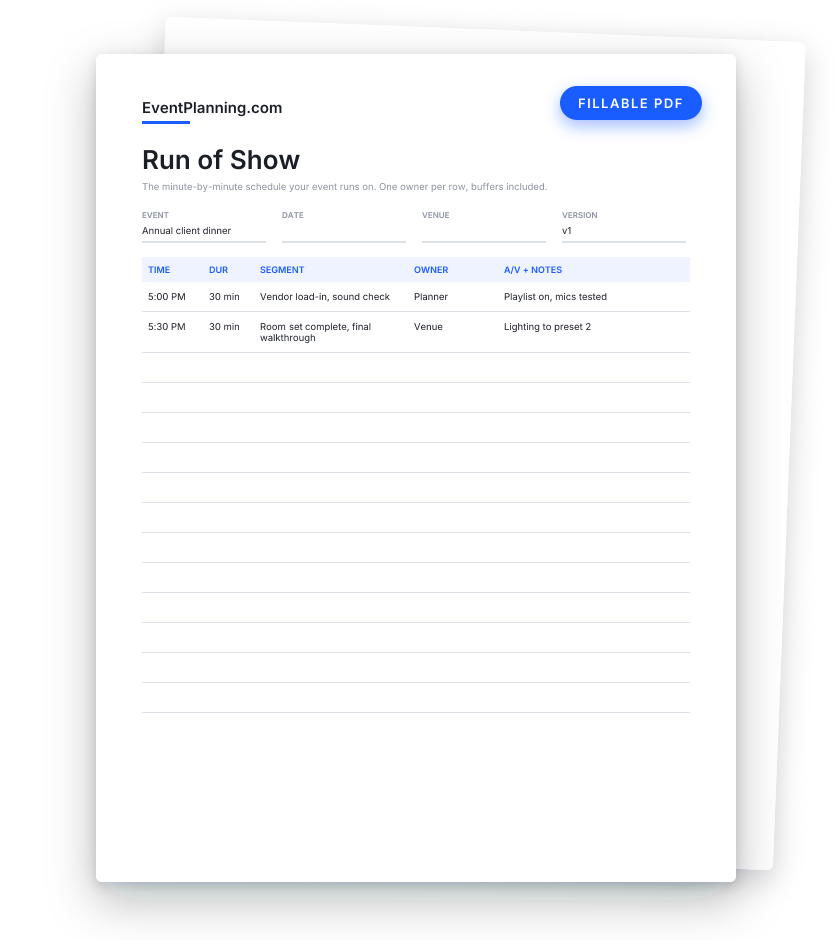
Download the free run of show template
Fillable PDF, 44 timeline rows plus header and day-of contacts. Type into it, save, print for the crew. No email required.
Download the fillable PDFWhat goes in each column
Time and duration. Real clock times, not "after dinner." Duration makes drift visible: when the toasts scheduled for 15 minutes hit 25, everyone running the event knows exactly what has to compress.
Segment. One activity per row, in plain words: "Vendor load-in," "Doors open," "Transition to dancing." If a segment needs a paragraph to describe, it is two segments.
Owner. The single name responsible for that row starting on time. One name, never a team. When two people own a cue, neither does.
A/V and notes. What the room does at that moment: which mic is hot, what plays over the speakers, when the lights change. This column is why the DJ, the venue, and the photographer all work from the same sheet.
How to build one that survives the event
Work backward from the fixed points. The ceremony start, the meal service, the venue's hard end time. Everything else flexes around the moments that cannot move.
Add buffers on purpose. Experienced planners pad transitions: guests take longer to sit than anyone believes, and speeches run long everywhere. A run of show with no slack is a schedule for the event you wish you were having.
Distribute it, then version it. Every vendor and every helper gets a copy the day before, and the sheet carries a version note so nobody runs the room off Tuesday's draft. Print copies for event day; phones die and venues have dead spots.
Run the day from it. The planner's copy gets marked up as the day moves. Where reality diverged is exactly what improves the next event's template, which is how our event operations guide recommends closing every event.
Run of show vs. agenda vs. itinerary
An agenda is what the audience sees: session names and times, no mechanics. An itinerary tracks people through places, common for travel and wedding parties. The run of show is the production document underneath both: it includes what the audience never sees, like load-in, sound checks, cue changes, and teardown. Guests get the agenda; the crew runs the show.
Get the editable Word version
The Word file carries the same table with 30 rows, ready for your branding and per-event copies. Enter your email and the download unlocks.
We will also send you our free 4-day planning mini course. Unsubscribe anytime.
Run of show FAQ
What is a run of show?
A run of show is the minute-by-minute production schedule for an event: each segment with its start time, duration, the person who owns it, and the audio, visual, and staging notes that go with it. Crews and vendors work from it on event day.
What is the difference between a run of show and an agenda?
The agenda is the audience-facing program. The run of show is the working document behind it, including everything guests never see: load-in, sound checks, cues, and teardown.
Who should get a copy of the run of show?
Everyone working the event: venue contact, caterer, DJ or band, photographer, day-of helpers, and speakers who need to know when they are on. Send it the day before and bring printed copies.
How detailed should a run of show be?
Detailed enough that any row can be handed to its owner and executed without a conversation. If two things happen at once, they get two rows.
Pairs well with: our free banquet event order template for coordinating with the venue and kitchen, and the event contract template for getting the booking on paper first. All of this lives inside the full planning process taught in the $47 course, which includes 49 working templates.