

Every event, from a backyard birthday to a corporate gala, fails or succeeds on the same forty-some decisions made in roughly the same order. This is that list. It is organized into seven phases keyed to how far out you are, so it works whether you have four months or four weeks, and it works across event types: the guest guarantee matters at a wedding and a sales conference alike.
The fillable PDF version has real checkboxes you can tick in any PDF viewer. The full checklist is also written out below, phase by phase, with notes on the items people learn the hard way.
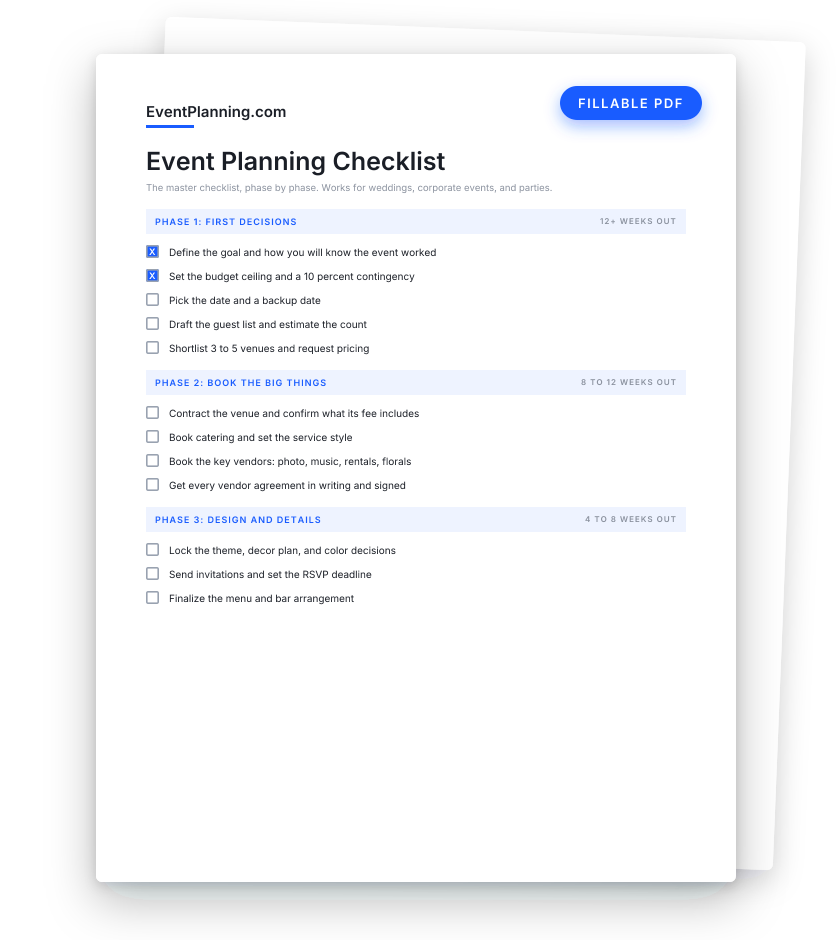
Download the free checklist
Fillable PDF with 42 clickable checkboxes across 7 phases, plus notes fields. Free, no email required.
Download the fillable PDFPhase 1: First decisions (12 or more weeks out)
Everything expensive that goes wrong later traces back to skipping something here. The goal line matters most: an event with no definition of success cannot be planned, only decorated.
- Define the goal and how you will know the event worked
- Set the budget ceiling and a 10 percent contingency
- Pick the date and a backup date
- Draft the guest list and estimate the count
- Shortlist 3 to 5 venues and request pricing
- Decide who owns which decisions (you, client, committee)
- Open a single tracking document for every decision and payment
Phase 2: Book the big things (8 to 12 weeks out)
The venue and the key vendors book out first, and everything in writing is the rule with no exceptions. Our free contract template handles the client side; vendor agreements deserve the same discipline.
- Contract the venue and confirm what its fee includes
- Book catering and set the service style
- Book the key vendors: photo, music, rentals, florals as needed
- Get every vendor agreement in writing and signed
- Confirm insurance requirements with the venue
- Set the payment calendar for every deposit and balance
- Send save-the-dates if the event calls for them
Phase 3: Design and details (4 to 8 weeks out)
The creative phase, run against the budget from Phase 1 rather than against Pinterest. Dietary and accessibility checks live here because fixing them costs nothing now and everything on event day.
- Lock the theme, decor plan, and color decisions
- Send invitations and set the RSVP deadline
- Finalize the menu and bar arrangement
- Plan audio visual: mics, speakers, screens, playlists
- Order rentals: tables, chairs, linens, extras
- Book staffing for setup, service, and teardown
- Confirm dietary restrictions and accessibility needs
Phase 4: Lock it down (2 to 4 weeks out)
Two documents rule this phase. The guest guarantee to the venue is a hard deadline with money attached, explained in our BEO guide. And the run of show gets drafted now, while there is still time to fix what it reveals.
- Give the venue the guest guarantee before the deadline
- Finish the seating plan
- Draft the run of show and circulate it for comments
- Reconfirm every vendor: arrival time, scope, contact
- Make final payments on schedule
- Build the day-of kit: tape, scissors, chargers, pens, meds
Phase 5: Event week (the final days)
Confirmation calls feel redundant right up until the one that catches a vendor with the wrong date. Five minutes of calls beats one empty florist slot.
- Confirmation call or text to every vendor
- Final guest count to catering
- Print the run of show and the contact sheet
- Walk the venue one final time
- Stage everything you are transporting yourself
Phase 6: Event day
Arrive first, work the plan, and let the run of show do the thinking. Setup photos before doors are for your portfolio; after doors, the room belongs to the guests.
- Arrive first, walk the space against the run of show
- Check in every vendor on arrival
- Run the day from the run of show, one owner per cue
- Capture photos of the setup before guests arrive
- Close out: teardown, load-out, venue walkthrough
Phase 7: The week after
The week most people skip, which is why most people replan every event from scratch. The review, the referral, and the debrief are how one event becomes the next three.
- Pay every remaining invoice
- Send thank-yous to client, vendors, and helpers
- Collect photos and add the best to your portfolio
- Ask for the review and one referral introduction
- Debrief: what drifted from plan, and fix the template
Adapting it by event type
The spine stays the same; the emphasis moves. Weddings stretch Phase 1 across months and add traditions with their own clocks, covered in our wedding timeline guide. Corporate events compress everything and add approval layers, so the decision-owner item in Phase 1 becomes the whole game. Parties run the same list at smaller scale, and our party planning guide covers that lane. For the planning process behind the checklist, start with the eight steps.
Get the editable Word version
The same checklist as a Word table with check, item, and notes columns, ready to customize per event type. Enter your email and the download unlocks.
We will also send you our free 4-day planning mini course. Unsubscribe anytime.
Checklist FAQ
How far in advance should you start planning an event?
Twelve or more weeks for most full events, which is where this checklist begins. Large weddings and conferences commonly start 6 to 12 months out. With less time, run the same phases compressed and cut scope, never the confirmation steps.
What is the first thing to do when planning an event?
Define the goal and how you will measure success, then set the budget ceiling. Every later decision, from venue to menu, is easier when those two exist.
What gets forgotten most often?
The guest guarantee deadline to the venue, vendor reconfirmation calls in event week, and the post-event debrief. All three are on the list because they are the expensive ones.
Does this checklist work for weddings and corporate events?
Yes. The phases and most items are identical across event types; the adaptation section above covers where the emphasis shifts for weddings, corporate events, and parties.
The complete template set: this checklist pairs with our free template library: contract, proposal, run of show, BEO, and price list. The full planning process behind all of them is taught in the $47 course, 49 templates included.
If you find this information helpful, please share it.