
Every horror story in this industry starts the same way: there was no contract. The client who cancels two weeks out and wants the deposit back. The guest list that doubles after the price was set. The vendor who no-shows and somehow becomes your fault. A one-page agreement prevents most of it, and you do not need to buy one.
Below is our free event planning contract template. The PDF version is fillable, so you can type directly into it and send it for signature today. No email address required, no catch. If you want the editable Word version to customize clause by clause, that one costs an email. Both are built from the same agreement, and this page walks through every clause so you understand what you are signing people to.
Download the free template
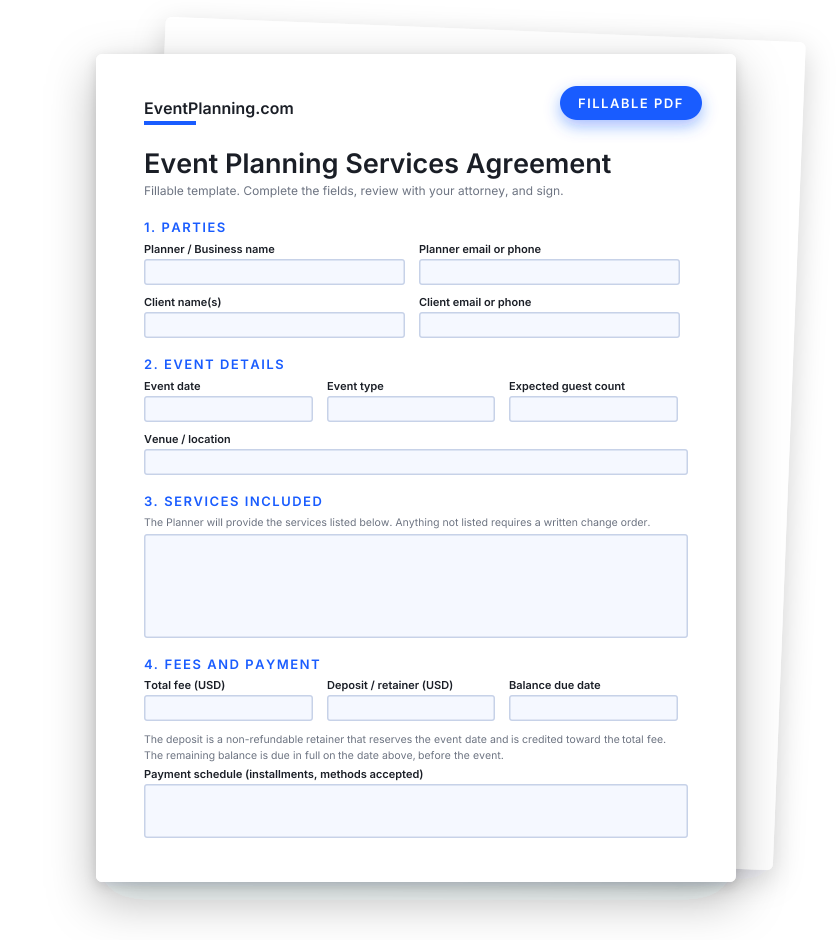
Two pages, 19 fillable fields. Type into it in any PDF viewer, save, and send for signature. Free to download and share.
Download the fillable PDFSample for reference only. Have a local attorney review before use.
What the template covers
This is a plain-English services agreement for private event work: parties and contacts, event details, a services scope section, fees with a non-refundable retainer structure, a payment schedule, and the eight protective clauses explained below. It fits birthday parties, showers, corporate socials, and wedding coordination alike, because the failure points of event work are the same everywhere: money, dates, scope, and blame.
It is deliberately two pages. Clients actually read two pages, and a contract a client has read is a contract that prevents arguments instead of winning them later.
The clauses, and why each one is there
The non-refundable retainer
The deposit is written as a retainer that reserves the date and is credited toward the total. This is the single most important sentence in the agreement. When you hold a Saturday in May for a client, you are turning away everyone else who wanted it; if they cancel, the retainer is what keeps that from being free. Calling it a retainer rather than a deposit also matters, since deposits are commonly assumed refundable. Pair it with pricing that reflects your market, and if you have not set that yet, start with our guide to charging for event planning and the pricing calculator.
Balance due before the event
The full balance lands before the event date, never after. After the party, your leverage is gone and your invoice becomes a suggestion. The template also pauses planning work when a payment is more than five days late, which turns awkward chasing into a simple stated consequence.
Cancellation and rescheduling
The template keeps the retainer on any cancellation, requires the full balance when cancellation happens inside 30 days, and allows one free reschedule within 12 months. That last part is the goodwill valve: clients hit real emergencies, and one documented reschedule keeps the relationship while the second one converts to a rebooking so the date games end.
Force majeure
The clause everyone learned to take seriously in 2020. When something genuinely outside anyone's control stops the event, the template sends both parties to rescheduling first, and if that fails, you keep the retainer for work performed and return unearned prepayments. Fair in both directions, which is what makes it enforceable in practice.
Scope and guest count changes
A party planned for 50 that becomes a party for 90 is a different job at the same price unless the contract says otherwise. The template sets a 10 percent guest-count threshold and requires written approval of revised pricing before the changed work happens. Scope creep does not announce itself; this clause is the tripwire.
Vendors contract with the client
Unless you are explicitly reselling vendor services, the caterer and photographer work for the client directly, and you coordinate. The distinction decides who eats the loss when a vendor fails. Without this clause, you become the guarantor of every business you recommend.
Limitation of liability
Your exposure is capped at what the client actually paid you. A planner charging $1,800 for a birthday party should not be carrying uncapped liability for a $30,000 event. This cap is the difference.
Photography and portfolio rights
Your next client hires you off photos of this one. The clause covers non-identifying setup and decor shots for your portfolio, and the note telling clients they can strike it is intentional: offering the out builds trust, and almost nobody takes it.
How to use it
Fill in your details, define the services scope precisely (vagueness in Section 3 is where disputes are born), set your fee and retainer, and send it for signature before any planning work starts. Family and friend events included, especially family events. Then have a local attorney give it one review pass adapted to your state; that costs far less than the first dispute it prevents. For the fuller walkthrough of contract mechanics, our guide to creating an event contract goes deeper.
Want the editable Word version?
The Word file is the same agreement with every clause editable, for planners who want to adapt the language, add their branding, or build service-specific variants. Enter your email and the download unlocks.
We will also send you our free 4-day planning mini course. Unsubscribe anytime.
Contract template FAQ
Is this event planning contract template really free?
Yes. The fillable PDF downloads directly with no email required, and you can share it. The editable Word version asks for an email. Both carry the same agreement.
What should an event planning contract include?
At minimum: the parties, the event details, a precise services scope, the total fee with a non-refundable retainer, a payment schedule with the balance due before the event, and clauses covering cancellation, force majeure, scope changes, vendor responsibility, and liability.
Do I need a lawyer to use a contract template?
You can sign clients with a template, and many planners do. The smart middle path is using a solid template and paying a local attorney for one review pass adapted to your state. Contract law details vary by state, and this template is a sample, never legal advice.
Can I use this template for weddings?
Yes, it works for wedding coordination as written. Full-service wedding planning at higher fees deserves additional wedding-specific language, and our wedding planner guide covers what that tier involves.
Want the full toolkit? The $47 Become an Event Planner course includes 49 working templates: proposals, invoices, checklists, client questionnaires, and the complete planning process they belong to.