
Every salary article about event planning quotes one national average and moves on. That number is real, but it hides the part that matters: an employed corporate planner in Chicago, a hotel convention manager, and a self-employed wedding planner running 30 events a year live in three different economies. Here are the actual numbers for each, current as of 2026.
The short answer
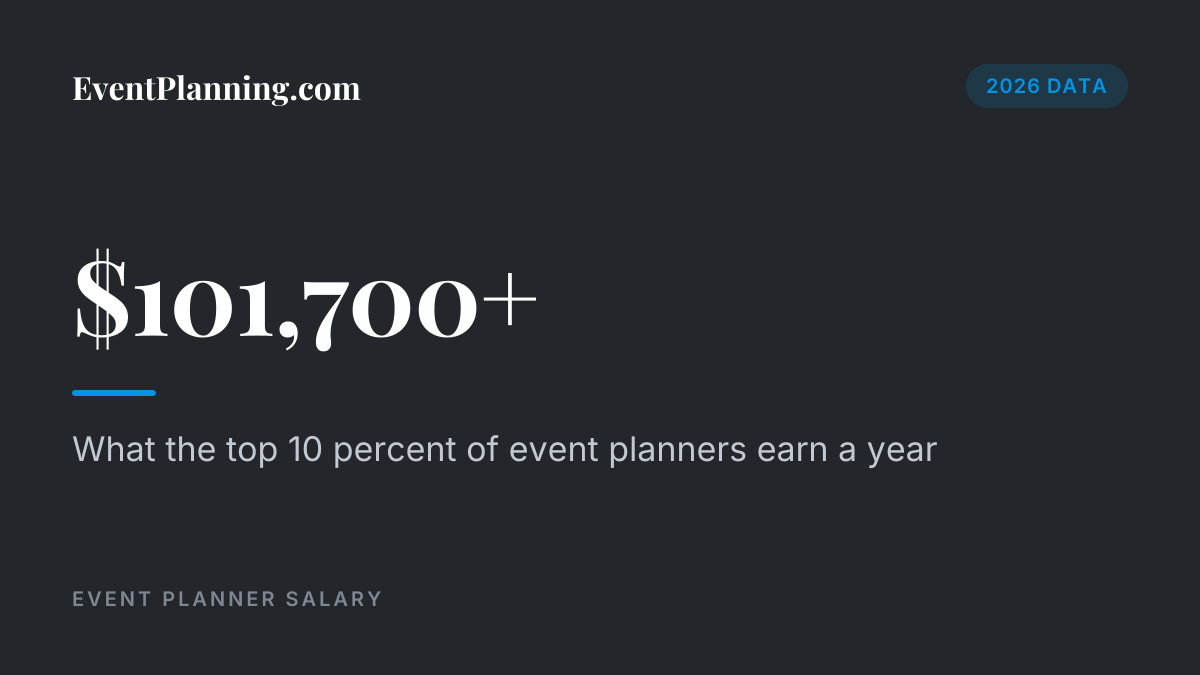
The median salary for meeting, convention, and event planners is $61,160 per year ($29.41 per hour). That is the most recent federal figure, from the Bureau of Labor Statistics (May 2025 data, released April 2026). The lowest 10 percent earn under $36,830. The highest 10 percent earn over $101,700.
Self-employed planners price per event instead: $1,500 to $3,500 for month-of coordination, $2,500 to $6,000 for partial planning, and $4,000 to $12,000 for full planning at typical US budgets. Established independents in our network report $2,300 to $5,500 per event.
What the federal data shows
The Bureau of Labor Statistics counts 142,860 employed planners in its May 2025 wage survey and projects 5 percent growth through 2034, faster than the average occupation. Here is how pay spreads across the field:
US event planner pay, percentile by percentile
Annual wage, employed meeting, convention, and event planners. May 2025 federal data.
| Percentile | Annual pay | What it usually means |
|---|---|---|
| Bottom 10% | Under $36,830 | Entry-level coordinators, small markets, assistant roles |
| Median | $61,160 | Mid-career planners with 3 to 7 years of experience |
| Top 10% | Over $101,700 | Senior corporate and convention planners, major metros, team leads |
Entry-level coordinator roles typically start between $38,000 and $45,000, which is consistent with what we see in current event planning job listings.
One note on education, since it surprises people: BLS lists a bachelor's degree as the typical entry credential, but no license or degree is legally required to plan events in any US state. Plenty of working planners came from hospitality, admin, or retail backgrounds and learned the craft directly. Employers care about executed events; clients care even more.
Salary by industry
Where you plan matters as much as how long you have planned. Median annual wages by industry, from the May 2024 industry breakdown, the most recent published:
| Industry | Median annual wage |
|---|---|
| Professional, civic, and grantmaking organizations (associations, foundations) | $60,940 |
| Administrative and support services (agencies, corporate event firms) | $60,510 |
| Accommodation and food services (hotels, venues, caterers) | $57,400 |
| Arts, entertainment, and recreation | $49,760 |
The pattern to notice: association and corporate work pays the most, hotel and venue work pays reliably but a bit less, and arts organizations pay the least in cash while often offering the most interesting rooms to work in. Hotel roles frequently add commission on top of base, especially in catering sales, which can close that gap for strong sellers.
What employed planner roles pay
Titles vary wildly, but employed planning careers cluster into a few tracks:
- Event or marketing coordinator. The standard entry door. Expect $38,000 to $45,000 to start, with fast movement if you take ownership of real events early.
- Corporate event planner or meeting planner. The core of the field and the center of that $61,160 median. Product launches, sales kickoffs, internal conferences.
- Convention and conference planners. Association annual meetings and trade shows. Steady, senior versions of these roles are where six figures shows up in the federal data.
- Venue, hotel, and catering event managers. Base plus commission is common. Sales ability moves pay here more than tenure does.
- Nonprofit and fundraising event planners. Galas, walks, donor dinners. Salaries run modest, and the portfolio you build is excellent.
If you are weighing these tracks, our free career quiz matches your situation (career changer, side income, wedding-focused, corporate) to a realistic starting path in about two minutes.
Self-employed planners: the per-event math
Independent planners do not earn a salary. They price packages, and their annual income is bookings times average fee minus business costs. These are the 2026 US benchmark ranges we publish across our tools:
| Service | Typical fee | Notes |
|---|---|---|
| Month-of / day-of coordination | $1,500 to $3,500 | The usual first offer for new planners |
| Partial planning | $2,500 to $6,000 | Client keeps some vendors, you run the rest |
| Full planning | $4,000 to $12,000 | Often 10 to 15% of budget on larger events |
| Consulting | $50 to $150/hr | For advice-only engagements, not full planning |
Established independents in our network report earning $2,300 to $5,500 per event across a mixed calendar. The math compounds with experience. A realistic first year working part time might be 10 month-of coordinations at $1,800 each, about $18,000 gross. A realistic third year running full time might be 30 bookings at a $4,000 average, about $120,000 gross, before business costs that usually eat 20 to 30 percent (insurance, software, marketing, assistants on event days).
Those two illustrations bracket the honest truth about independent planning: the ceiling is far higher than employed work, and the floor is lower. The variable you control most directly is pricing. Planners who quote packages anchored to outcomes consistently out-earn planners who bill hourly, because hours are invisible to clients and outcomes are not. Our free pricing calculator gives you a quote range for your market and experience level, and the budget calculator shows what clients in your metro actually spend.
Those per-event numbers depend entirely on how you structure your fees. Our guide to what event planners charge breaks down the five pricing models and the going rate for each.
What actually raises a planner's income
Across employed and independent planners, four levers move the number more than anything else:
- Executed events you can show. A portfolio of real events, even small or volunteer ones, moves you out of the bottom decile faster than any course or degree. Document everything you run.
- A niche. Corporate retreats, nonprofit galas, South Asian weddings, medical conferences. Specialists quote higher with less pushback because they are compared to fewer alternatives.
- Sales and negotiation skill. This is the quiet one. Venue commissions, package upsells, and vendor margins all reward planners who can sell. It is why hotel catering sales pays above its title.
- A verifiable credential. No state requires one, and clients still check for one. A certification a client can verify in five seconds does its best work at quoting time, when you are asking for the top of your range. That is exactly what our Certified Event Planner (CEP) Foundations program was built for, and we compared it honestly against every major alternative in our certification guide.
Does location change the number?
Substantially. Employed planner wages in major coastal metros run meaningfully above the national median, and event-dense markets (New York, Los Angeles, Chicago, Dallas, Miami, Las Vegas, Phoenix) support far more independent planners at the top of the fee ranges. Higher budgets cut both ways for independents: a full-planning fee at 10 to 15 percent of a $60,000 metro wedding is a different business than the same percentage of a $20,000 hometown one. Pick your state below for local numbers.
Event planner salary by state
Median annual wage for meeting, convention, and event planners in each state, from the May 2025 federal data. Every guide has the full pay range, nearby-state comparisons, and notes on the local market.
The 10 highest-paying states for event planners
Median annual wage by state, May 2025 federal data. Gray line marks the national median.
Idaho is not listed this year: the federal survey suppressed its planner estimates for May 2025.
Event planner salary FAQ
How much do event planners make per hour?
Employed planners earn a median of $29.41 per hour in the latest federal data. Independent planners billing hourly for consulting typically charge $50 to $150 per hour, but most price full engagements per event instead.
What does an entry-level event planner make?
Coordinator roles usually start between $38,000 and $45,000. The bottom 10 percent of all employed planners earn under $36,830, which is the realistic floor for a first year in a small market.
How much do wedding planners make per wedding?
Month-of coordination runs $1,500 to $3,500, partial planning $2,500 to $6,000, and full planning $4,000 to $12,000 at typical US wedding budgets. Full planning on luxury budgets is usually quoted at 10 to 15 percent of spend. The wedding planner salary guide has the full per-wedding and annual math.
Is event planning a good career financially?
The field is growing 5 percent through 2034, faster than average, and the top 10 percent of employed planners clear $101,700. Self-employment raises the ceiling further and adds variance. It rewards people who like ownership, sales, and pressure. If that sounds like you, take the two-minute career quiz and see which path fits.
Find out what you could earn in your market
Two minutes, no email required to see your result.
Take the free career quizSources: US Bureau of Labor Statistics, Occupational Outlook Handbook and Occupational Employment and Wage Statistics for meeting, convention, and event planners (May 2025 data, the most recent federal release, bls.gov); EventPlanning.com 2026 pricing benchmarks. Our event planning statistics page collects these figures alongside fee benchmarks, certification costs, and growth projections, refreshed quarterly. Independent planner figures describe typical ranges, not guarantees.